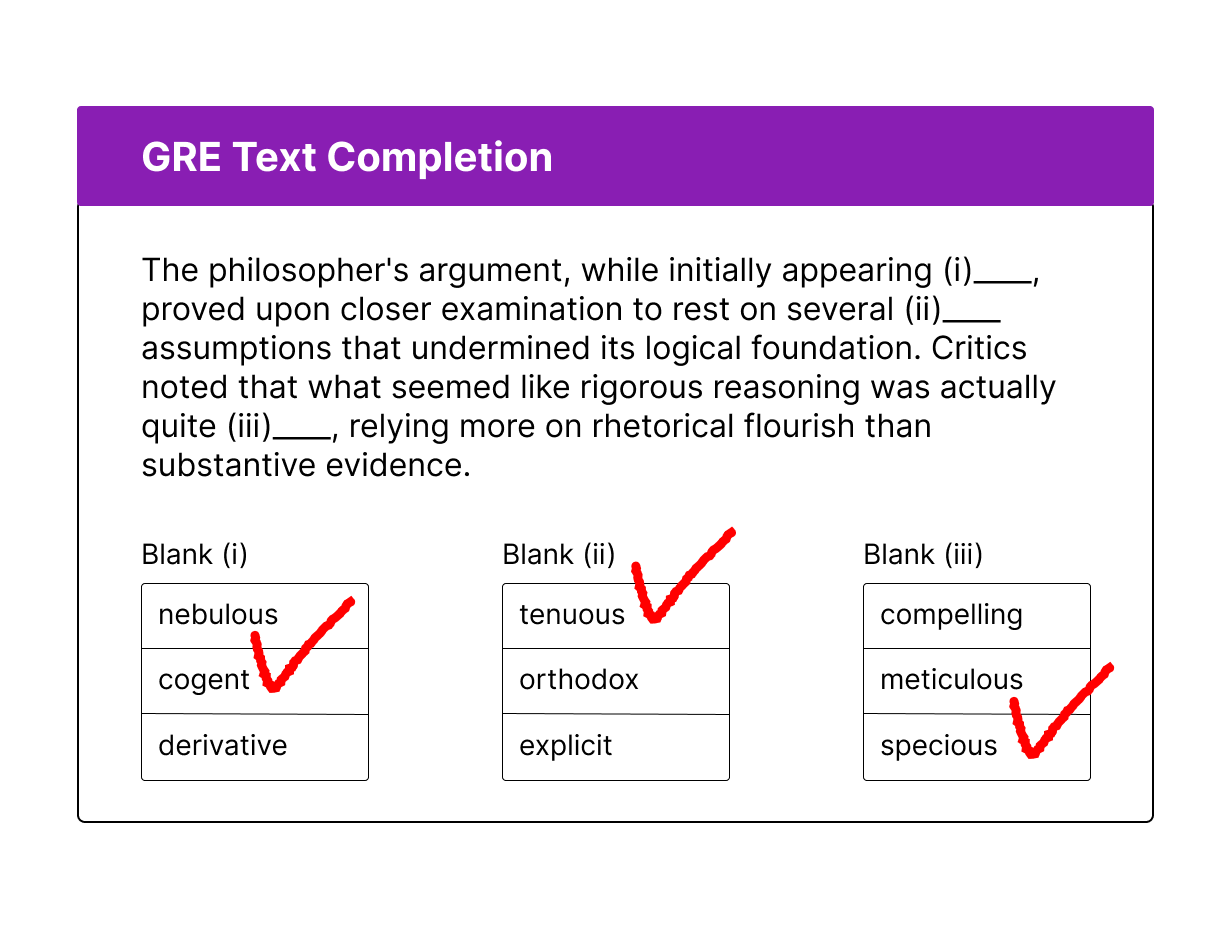
Text Completion is one of the three question types in GRE Verbal Reasoning. These questions test your ability to interpret meaning from context and select words that logically complete passages. This guide covers strategies for all Text Completion formats: single-blank, double-blank, and triple-blank questions.
GRE Text Completion Format
Text Completion questions present passages with one to three blanks. You must select the best word or phrase for each blank from the given options.
Question Types
Single-Blank Questions
5 answer choices, select 1. Typically 1-2 sentences.
Double-Blank Questions
3 answer choices per blank, select 1 for each. Each blank scored independently.
Triple-Blank Questions
3 answer choices per blank, select 1 for each. Longer passages with complex logic.
Scoring Note
For multi-blank questions, you must get all blanks correct to receive credit. There is no partial credit.
Core Strategy: The RICE Method
Use this four-step approach for every Text Completion question:
R - Read the entire passage first
Understand the overall meaning before looking at answer choices. Ignore the blanks initially.
I - Identify context clues
Look for signal words (however, moreover, therefore) and key phrases that indicate tone and logic.
C - Create your own word
Predict what type of word should fill each blank before looking at choices. Use simple words like "good," "bad," "increase," or "decrease."
E - Evaluate answer choices
Match your prediction to the closest answer choice. Eliminate options that don't fit the context.
Essential Context Clues
Context clues are words or phrases that signal the relationship between ideas. Recognizing these patterns is crucial for Text Completion success.
Contrast Signals
These words indicate the blank should have an opposite meaning to another part of the sentence:
Continuation Signals
These words indicate the blank should have a similar meaning or continue the same idea:
Cause and Effect Signals
These words show logical consequences or results:
Practice Examples with Analysis
Single-Blank Example
Despite the author's reputation for _______ prose, her latest novel surprised readers with its accessibility and straightforward style.
Answer choices:
- (A) lucid
- (B) abstruse
- (C) eloquent
- (D) terse
- (E) melodious
Analysis
The signal word "despite" indicates contrast. The blank must contrast with "accessibility and straightforward style." We need a word meaning difficult or complex. Answer: (B) abstruse (difficult to understand).
Double-Blank Example
The diplomat's (i)_______ approach to negotiations proved effective; rather than making demands, she (ii)_______ consensus through patient dialogue.
Blank (i)
- (A) bellicose
- (B) conciliatory
- (C) capricious
Blank (ii)
- (D) undermined
- (E) fostered
- (F) obviated
Analysis
The phrase "rather than making demands" and "patient dialogue" suggests a peaceful, cooperative approach. Blank (i): conciliatory (seeking agreement). The result is building consensus. Blank (ii): fostered (encouraged, cultivated). Answer: (B), (E).
Common Traps to Avoid
Trap 1: Choosing words that "sound right"
Wrong answers often contain sophisticated vocabulary that sounds impressive but doesn't fit the context. Always verify meaning matches the passage logic.
Trap 2: Ignoring all context clues
Don't just focus on words immediately around the blank. The key clue might be at the beginning or end of a longer passage.
Trap 3: Using outside knowledge
Answer based only on information in the passage. Don't let your personal knowledge about a topic influence your choice.
Trap 4: Rushing multi-blank questions
For double and triple blanks, solve each blank independently first, then verify all answers work together logically.
Frequently Asked Questions
Which blank should I solve first in multi-blank questions?
Start with the blank that has the clearest context clues. This is often not the first blank in order. Solving the easier blank first can help you understand the overall meaning.
How much time should I spend per Text Completion question?
Aim for 1-1.5 minutes for single-blank questions and 1.5-2 minutes for multi-blank questions. If you're stuck, make your best guess and move on.
What if two answer choices seem equally correct?
Re-read the passage for subtle context clues you may have missed. Look for connotation differences between the words. One answer will have a more precise fit.
Master GRE Text Completion Vocabulary
Build the vocabulary foundation you need for Text Completion success. 26s helps you learn high-frequency GRE words in context with spaced repetition.
Start Learning GRE Vocabulary